Learn what VAR means in football, which decisions it can review, how checks differ from reviews, and the limits under the 2026/27 rules.
VAR stands for video assistant referee: a match official who uses replay footage to help the referee assess specific incidents. It supports decisions about goals, penalties, dismissals, and mistaken identity, with an optional corner provision under the 2026/27 Laws.
For Ugandan viewers, the essential distinction is scope. Television replays can reveal many mistakes, but VAR cannot intervene simply because an incident looks debatable.
Rules checked: 10th November 2026.
What does video assistant referee mean?
The video assistant referee is a person, not the cameras, screens, or replay software. Technology supplies evidence; officials interpret it.
The referee controls the match on the pitch. The VAR examines footage and communicates relevant findings. An assistant VAR supports that work, including monitoring play while the VAR concentrates on an incident.
Think of a hypothetical penalty appeal: the referee initially allows play to continue, while video officials examine whether intervention is justified.
What can VAR check in football?
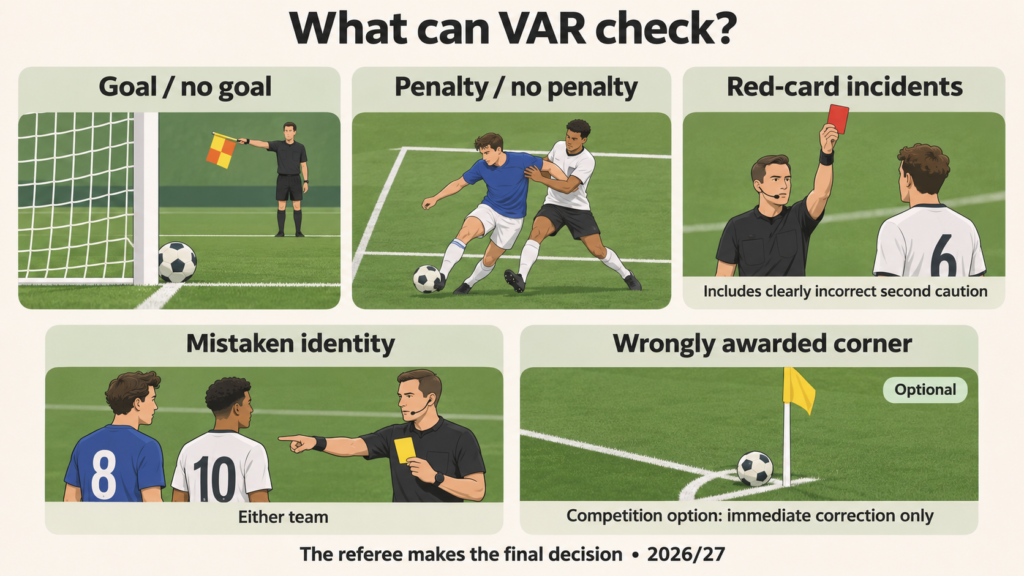
The following categories describe the permitted scope. Examples are hypothetical, and any intervention must satisfy the applicable protocol.
| Incident | Scope and example |
| Goal or no goal | Relevant attacking fouls, handball, offside, or the ball leaving play. Example: an attacker fouls a defender during the scoring move. |
| Penalty or no penalty | Whether a penalty offence occurred, including its location. Example: replays establish that a trip occurred outside the area. |
| Red-card incidents | Sending-off offences, including a clearly incorrect second caution causing dismissal. Example: footage disproves the offence behind that second booking. |
| Mistaken identity | Correcting a card given to the wrong player when another player of either team committed the offence. |
| Clearly wrongly awarded corner | Competitions may permit immediate correction without delaying the restart. Example: footage immediately shows the attacker touched the ball last. |
The corner provision is optional. A competition using VAR does not automatically adopt it.
What is the difference between a VAR check and a review?
A check is the video officials’ examination of a potentially reviewable incident. Many checks happen quietly while play continues and end without changing anything.
A review is a further decision-making process initiated by the referee, potentially following a recommendation from the VAR.
For subjective incidents, such as judging a challenge’s seriousness, the referee normally examines footage at the pitchside monitor.
For factual matters, such as whether an offence occurred inside the penalty area, information communicated by the VAR may suffice. A monitor visit is therefore not compulsory whenever a decision changes.
What does “clear and obvious error” mean?
The expression describes the intervention threshold for overturning an original judgement. VAR does not exist to replace every arguable decision with another official’s preference.
Consider two hypothetical challenges. One involves contact whose significance reasonable observers dispute. Another replay clearly shows the supposed offender never touched the opponent.
The second offers stronger grounds for intervention. Disagreement alone does not establish an obvious mistake.
Factual questions differ from subjective assessments. Establishing location involves different evidence from judging whether contact constitutes a foul. A serious incident missed by officials can also justify intervention within VAR’s scope.
What can VAR not routinely review?
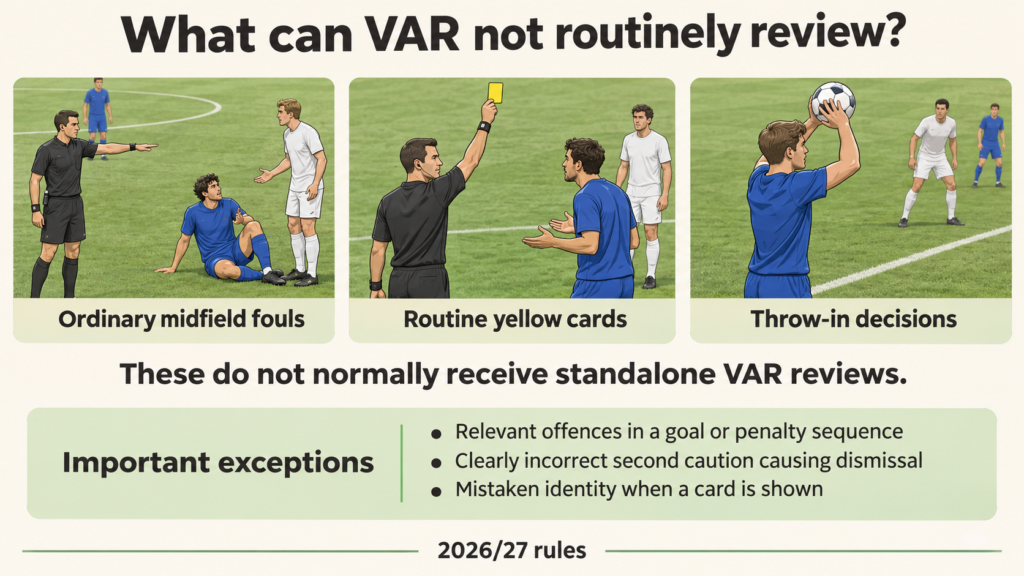
Ordinary midfield fouls, routine yellow cards and throw-in awards do not receive standalone reviews simply because footage suggests an error.
However, a relevant attacking offence may be examined within a reviewable goal or penalty sequence.
The second-yellow exception is specific: it concerns a clearly incorrect caution that produces a dismissal. It does not make every booking reviewable or generally permit VAR to award a missed second caution.
Mistaken identity provides another limited exception involving disciplinary action. The optional corner rule likewise does not create unrestricted video checking of every restart.
Who makes the final decision, and why can checks take time?
The referee makes the final decision. Video officials recommend and provide information; they do not independently replace the referee’s authority.
Different angles can clarify contact, positioning or the sequence of events. Officials may need to establish several connected facts before reaching a conclusion.
There is no fixed maximum review time. Accuracy takes priority over speed, although unnecessary delay should be avoided.
A longer check does not prove that a decision must change. Equally, a quick check does not automatically indicate carelessness.
What should Ugandan football viewers check?
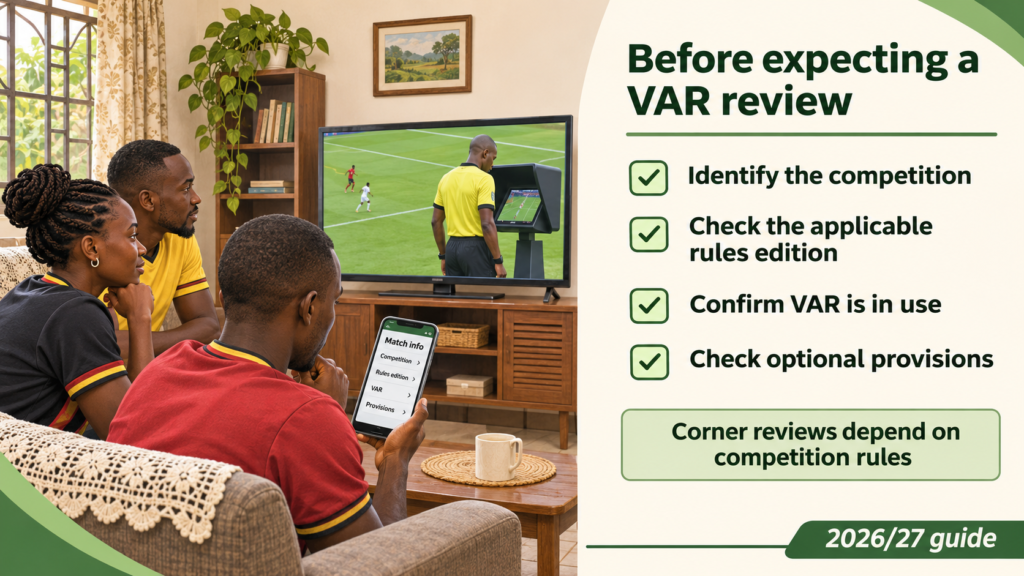
Whether watching in Kampala, Jinja, Gulu or Mbarara, identify the competition, the applicable Laws edition and whether VAR operates in that fixture.
Do not assume every Uganda Premier League match, Cranes international or continental competition uses identical arrangements.
Check whether optional provisions apply. An explanation from a previous season may omit the second-caution change or describe corners too broadly.
When discussing a disputed incident with fellow supporters, separate three questions: was the decision wrong, was that type of incident reviewable, and did the evidence meet the intervention threshold? Keeping those questions distinct makes discussion more useful than assuming every replay should trigger a referee intervention.
Frequently asked questions
What does VAR stand for in football?
Video assistant referee, the official supporting specific refereeing decisions through replay footage.
Does every VAR check require the referee to visit the monitor?
No. Checks may conclude silently, and factual reviews can use information communicated directly.
Can VAR review a second yellow card?
Yes, when a clearly incorrect second caution results in dismissal under the 2026/27 provision.
Can VAR change a corner-kick decision?
Only under the competition option, with immediate correction that does not delay the restart.
Can players or coaches demand a VAR review?
No. They cannot compel a review or control the referee’s decision.
Is there a time limit for a VAR review?
No fixed maximum applies; accuracy is prioritised.
Follow the decision and check the rules
Use IFAB’s 2026/27 VAR protocol and law changes as primary references.
For betting-related interruptions, read why a live market may be suspended during a video review. General instructions belong in how sports-betting markets and bet slips work.
Verdict
VAR has defined responsibilities, specific exceptions, and competition-dependent options. Understand the incident category before expecting intervention, and remember that the referee retains final authority.