Understand baccarat’s third card rule, natural hands, and the Banker’s drawing table, with clear examples showing when each hand draws or stands.
In standard punto banco baccarat, fixed rules determine whether Player and Banker receive a third card. Neither hand draws when either has an initial two-card total of eight or nine. Otherwise, resolve Player’s action first, then apply Banker’s drawing rule. These procedures appear in Pragmatic Play’s baccarat game-help document.
Player and Banker name the hands. The customer does not choose whether either receives another card. The baccarat third card rule explains why Banker can draw on six yet stand on three, depending on the value of Player’s third card.
What is the baccarat third card rule?
The third-card rule determines whether dealing stops after the initial four cards or continues to five or six cards across both hands.
Baccarat 1’s Game Help panel on Bangbet contains a dedicated “The Third Card Rule” section, including Player’s instructions and Banker’s complete drawing chart.
For a brief scoring reminder, aces count as one, cards two through nine retain their values, and tens and picture cards count as zero. Only the final digit of the sum counts: 7 + 8 produces five.
Read baccarat hand labels and card values for the fuller explanation.
Check for a natural before drawing
A natural is an initial two-card total of eight or nine.
If either hand has a natural, both hands stop receiving cards. This takes priority over the instructions that would otherwise require a low-total hand to draw.
For example, Player nine against Banker four ends without another card. Banker does not draw simply because its total is low.
Baccarat 1 also identifies rounds ending after four cards when both hands stand on six or seven, including six against seven and ties on six or seven.
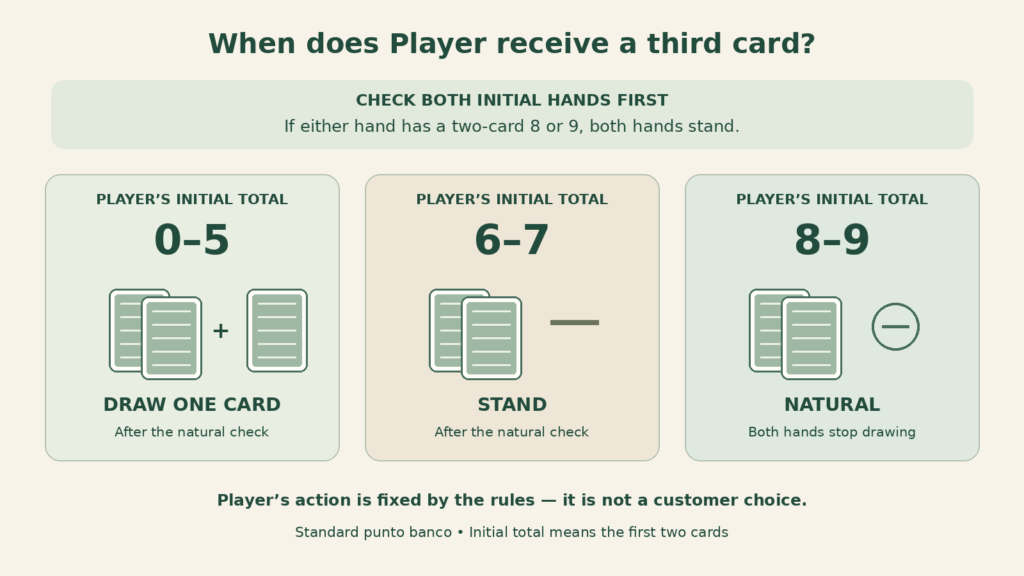
When does Player receive a third card?
After checking both hands for naturals, resolve Player’s action.
| Player’s initial two-card total | Action |
| 0–5 | Draw one card |
| 6–7 | Stand |
| 8–9 | Natural: both hands stand |
“Stand” means receiving no additional card.
If Player draws, note the point value of that specific third card. Banker’s next action may depend on it.
Player receiving an eight as a third card is different from Player finishing with a total of eight.
What happens when Player stands?
When Player stands on six or seven and neither hand has a natural, Banker follows a simpler procedure:
| Banker’s initial total | Action |
| 0–5 | Draw one card |
| 6–7 | Stand |
Therefore, Player six against Banker five requires Banker to draw. Player six against Banker seven requires both hands to stand.
There is no Player third-card value to consult because Player received no additional card.
Banker’s third card rule explained
When Player draws, Banker’s decision uses its own initial total and Player’s third-card value.
It does not use Player’s final total. An ace has a third-card value of one; a ten, jack, queen, or king has a value of zero.
The following summarises Baccarat 1’s displayed drawing chart:
| Banker’s initial total | If Player stands | If Player draws |
| 0–2 | Draw | Draw regardless of Player’s third card |
| 3 | Draw | Draw unless Player’s third card is 8 |
| 4 | Draw | Draw if Player’s third card is 2–7 |
| 5 | Draw | Draw if Player’s third card is 4–7 |
| 6 | Stand | Draw if Player’s third card is 6 or 7 |
| 7 | Stand | Stand |
Banker stands whenever the specified drawing condition is not met. Initial totals of eight or nine have already stopped further drawing through the natural rule.
The different conditions explain why a higher Banker total can require another card while a lower total can require standing.
Worked examples of the drawing sequence
These are hypothetical teaching examples, not recorded Bangbet rounds.
Example 1: A natural stops drawing
- Player receives 4 + 5, totalling nine.
- Banker receives 2 + 2, totalling four.
- Player has a natural, so neither hand draws.
The natural check overrides Banker’s otherwise applicable drawing instruction.
Example 2: Player stands, and Banker draws
- Player receives 2 + 4, totalling six.
- Banker receives 2 + 3, totalling five.
- Neither hand has a natural. Player stands.
- Banker draws because its initial total is five.
If Banker receives a two, it finishes on seven.
Example 3: Banker stands on three
- Player starts with 2 + 3, totalling five.
- Banker starts with ace + 2, totalling three.
- Player draws an eight, finishing on three because 5 + 8 = 13.
- Banker stands because Player’s third card was eight.
The deciding value is eight, not Player’s final total of three.
Example 4: Banker draws on six
- Player starts with an ace + 3, totalling four.
- Banker starts with 2 + 4, totalling six.
- Player draws a six, finishing on zero.
- Banker draws because Player’s third-card value is six.
If Banker then receives an ace, it finishes on seven.
Common third-card misunderstandings
Confusing the third card with the final total: Banker’s conditional chart uses the card’s value, rather than the Player’s completed score.
Calling a three-card eight a natural: Natural status requires an initial two-card eight or nine.
Assuming Banker always draws on six: Banker six draws only when Player’s third card is six or seven.
Treating drawing as a customer decision: The dealing procedure determines the action automatically.
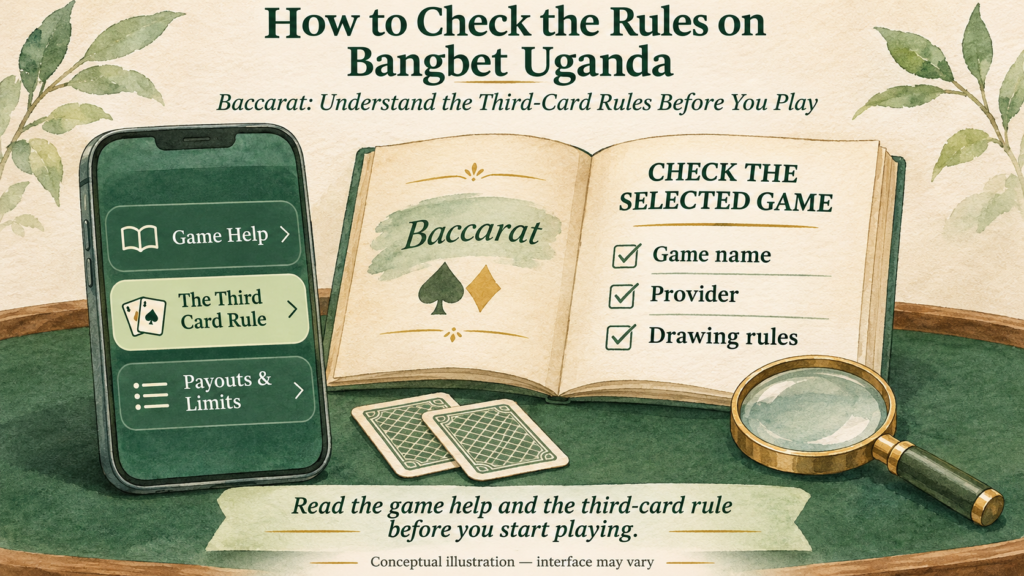
How to check the rules on Bangbet Uganda
Open the selected title through Bangbet Uganda’s casino lobby, confirm its name and provider, and read its Game Help panel.
For Baccarat 1, the drawing tables reviewed on 10 November 2026 match the sequence explained here. The chart uses D for Draw and S for Stand.
Confirm the rules again when changing products. Use Bangbet’s table-games guide for broader discovery.
Frequently asked questions
Can I choose whether Player receives another card?
No. Fixed rules determine the Player’s action.
Does Banker always draw on five?
No. When Player draws, Banker draws on a five only against a third-card value of four through seven.
Why does Banker sometimes draw on six?
Because Player drew a six or seven.
Does Banker use Player’s third card or final total?
The conditional chart uses Player’s third-card value.
Is a three-card total of nine a natural?
No. A natural requires an initial two-card eight or nine.
Can either hand receive a fourth card?
No. Each hand receives at most three cards under these rules.
Check the drawing rules before playing
Review the selected table’s help panel before committing money. For an unclear sequence, retain the round reference and contact Bangbet customer care.
25+ only. Gambling involves financial risk. Set affordable limits, never chase losses, and request self-exclusion if stopping becomes difficult. Consult Bangbet’s responsible-gambling guide.
Verdict
Check naturals first, resolve Player next, then apply Banker’s rule. Banker’s initial total alone does not always determine its action: Player’s third-card value can require drawing on six or standing on three.