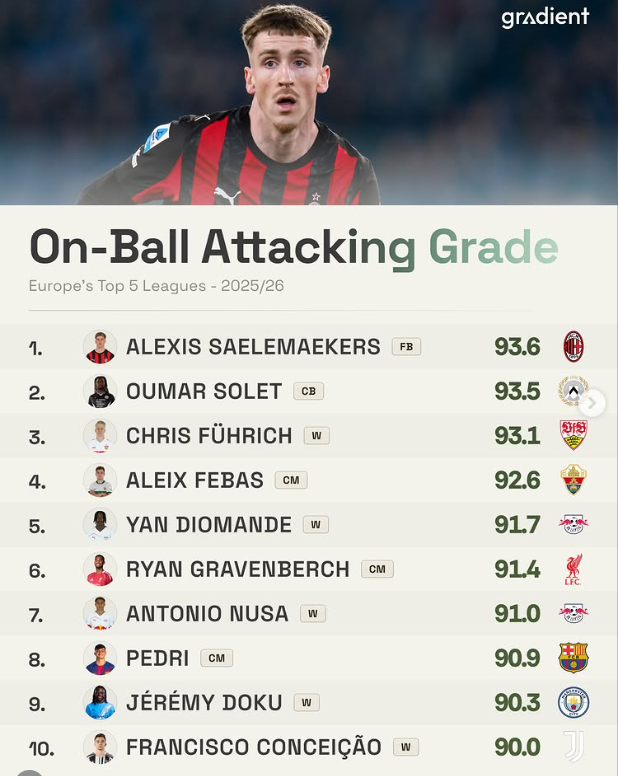
Alexis Saelemaekers ranks as the highest-graded on-ball attacking player across Europe’s top five leagues for 2025/26 in the supplied Gradient ranking, recording a 93.6 On-Ball Attacking Grade.
The AC Milan player narrowly leads Udinese defender Oumar Solet, who scores 93.5, while Stuttgart’s Chris Führich completes the top three on 93.1.
What makes the ranking particularly interesting is its methodology. Rather than simply counting successful dribbles or using completion percentages, the On-Ball Attacking Grade combines Tackle Resistance, Ball Carrying and Dribbling to evaluate what players actually do with the ball at their feet.
The resulting top 10 contains several surprising names alongside established stars such as Pedri, Jérémy Doku and Ryan Gravenberch.
Best On-Ball Players in Europe’s Top Five Leagues 2025/26
According to the supplied Gradient ranking:
The difference between first and tenth is only 3.6 points, but the bigger story is the variety of positions represented.
Five of the top 10 are listed as wingers, but the ranking also includes three central midfielders, one full-back and one centre-back.
That is important because elite on-ball ability is not restricted to attacking players.
What Is the On-Ball Attacking Grade?
Gradient’s On-Ball Attacking Grade is designed to measure a player’s non-distribution quality while in possession.
It combines three Facet Grades:
- Tackle Resistance
- Ball Carrying
- Dribbling
The objective is to assess how effectively a player operates when the ball is at their feet without reducing that ability to a simple dribble-success percentage.
According to the supplied methodology, every tackle faced, ball carry and dribble is manually graded on execution from -2 to +2 in increments of 0.5.
Adjustments are then made for difficulty before the result is normalized into a 0–100 grade.
That distinction matters.
A player completing five straightforward dribbles is not necessarily demonstrating the same on-ball quality as someone repeatedly escaping pressure or successfully carrying possession through more difficult situations.
Why This Is Different From Dribble Completion Percentage
Traditional dribbling statistics can tell us how often a player attempts or completes a dribble.
They do not necessarily tell the entire story of how well the action was executed or how difficult it was.
That is what the On-Ball Attacking Grade attempts to address.
Rather than treating every completed action equally, the grading system evaluates execution and adjusts for difficulty.
It also extends beyond dribbling.
Tackle resistance asks how a player responds when challenged for possession, while ball carrying captures another major element of advancing or maintaining possession with the ball at the player’s feet.
The result is a broader assessment of on-ball ability.
Alexis Saelemaekers Leads Europe With a 93.6 Grade
At the top of the ranking is Alexis Saelemaekers with a 93.6 grade.
His advantage is extremely small.
Oumar Solet is just 0.1 points behind, while Chris Führich trails the leader by only 0.5.
Saelemaekers’ position at No. 1 is especially notable because the graphic lists him as a full-back rather than a winger.
In a top 10 containing several highly regarded attacking players, a full-back taking first place illustrates why this particular metric can reveal qualities that conventional goals-and-assists rankings would miss.
The grade is not asking who scored the most goals.
It is asking who demonstrated the strongest combination of carrying, dribbling and resisting tackles when operating with the ball.
Oumar Solet Is the Biggest Positional Surprise
Perhaps the most eye-catching name is Oumar Solet.
The Udinese player ranks second with a 93.5 On-Ball Attacking Grade, only 0.1 behind Saelemaekers.
More importantly, Solet is listed as a centre-back.
Seeing a central defender ahead of Pedri, Doku, Gravenberch and several wingers immediately demonstrates the difference between this ranking and a conventional list of Europe’s most productive attackers.
The metric evaluates on-ball execution rather than goals, assists or attacking reputation.
For defenders, the ability to resist pressure and carry possession can be particularly valuable when a team attempts to progress the ball from deeper positions.
Solet’s ranking indicates that his graded actions in the supplied dataset were strong enough to place him among the very best performers regardless of position.
Chris Führich Completes the Top Three
Stuttgart winger Chris Führich ranks third with 93.1.
Unlike Solet, Führich fits the positional profile many readers might expect from an on-ball attacking leaderboard.
Wingers frequently find themselves in situations where they must take on defenders, carry the ball into dangerous areas or protect possession under pressure.
His grade places him only half a point behind Saelemaekers.
Aleix Febas Leads the Central Midfielders
Aleix Febas ranks fourth overall with a grade of 92.6, making him the highest-ranked central midfielder in the supplied top 10.
He sits ahead of Liverpool’s Ryan Gravenberch and Barcelona’s Pedri.
Central midfield is an interesting position for this type of measurement because midfielders can receive possession in crowded areas where maintaining control under pressure becomes especially important.
Again, the ranking does not establish that Febas is Europe’s “best midfielder” overall. It specifically grades the combination of tackle resistance, ball carrying and dribbling captured by this methodology.
That distinction should be maintained when interpreting the results.
Yan Diomande Makes the Top Five
RB Leipzig’s Yan Diomande completes the top five with a 91.7 grade.
He is also the first of two Leipzig players in the top 10, with Antonio Nusa appearing seventh.
Their inclusion means Leipzig join the ranking with two players among Europe’s 10 highest-graded performers in this specific category.
Ryan Gravenberch Ranks Sixth
Liverpool midfielder Ryan Gravenberch scores 91.4, putting him sixth.
He is the only Liverpool player shown in the top 10.
For central midfielders, carrying the ball and escaping pressure can provide a route for progressing possession without relying exclusively on passing.
The ranking suggests Gravenberch performed strongly across the on-ball actions assessed by Gradient.
Antonio Nusa Gives Leipzig Two Players in the Top Seven
Antonio Nusa ranks seventh with 91.0, just 0.7 behind Leipzig teammate Diomande.
Both players are classified as wingers in the graphic.
Leipzig are consequently the only club represented twice in this particular top 10.
Pedri Ranks Eighth Among Europe’s Best On-Ball Players
Barcelona midfielder Pedri sits eighth with a 90.9 grade.
His presence gives the ranking another elite central midfielder alongside Febas and Gravenberch.
The fact that Pedri is eighth rather than first also illustrates why the list should not simply be interpreted as a ranking of football’s most technically gifted players.
It measures a defined set of actions using a specific methodology.
Players can excel in other aspects of possession — particularly distribution and passing — that are deliberately outside the scope of this non-distribution on-ball grade.
Jérémy Doku Is Ninth With a 90.3 Grade
Manchester City winger Jérémy Doku ranks ninth on 90.3.
As a winger, Doku operates in a position naturally associated with one-on-one situations and ball carrying.
His inclusion alongside less obvious names such as Solet and Febas is another example of the ranking bringing together players whose roles can be dramatically different.
The common factor is their graded performance with the ball at their feet.
Francisco Conceição Completes the Top 10
Juventus winger Francisco Conceição rounds out the top 10 with a grade of 90.0.
That means every player in the supplied top 10 reaches at least 90 on Gradient’s normalized 0–100 scale.
Conceição is also the fifth player classified as a winger, making that the most common position on the leaderboard.
Which Positions Dominate the On-Ball Rankings?
The positional breakdown provides an interesting secondary insight.
Of the top 10:
| Position | Players in Top 10 |
|---|---|
| Wingers | 5 |
| Central Midfielders | 3 |
| Full-backs | 1 |
| Centre-backs | 1 |
Half of the top 10 are wingers.
That makes intuitive sense within a metric incorporating dribbling and ball carrying, because wide attackers are frequently asked to confront opponents directly.
But the presence of Saelemaekers and Solet at first and second shows why evaluating players across positions can produce unexpected results.
Why Tackle Resistance Matters
Dribbling receives considerable attention in football statistics, but tackle resistance provides another perspective on possession.
A player does not always need to beat an opponent with a conventional dribble to demonstrate on-ball quality.
They may instead protect possession, evade a challenge or maintain control when pressured.
By including tackle resistance alongside dribbling and carrying, the On-Ball Attacking Grade attempts to capture these situations rather than measuring only recognizable one-on-one take-ons.
Why Ball Carrying Matters
Passing is not the only way to move possession forward.
Players can also advance the ball by carrying it.
Strong carriers can potentially help a team escape pressure, move into space or progress possession into more advanced areas.
However, the On-Ball Attacking Grade described here should not be interpreted as an overall attacking rating. The supplied methodology specifically describes it as measuring non-distribution on-ball quality.
Passing and other aspects of football performance therefore require separate evaluation.
What the Rankings Tell Us — and What They Don’t
The leaderboard provides an alternative way to evaluate players who are comfortable with the ball at their feet.
It particularly highlights three things:
First, reputation is not everything.
Saelemaekers, Solet and Führich occupy the top three ahead of globally prominent players such as Pedri and Doku.
Second, on-ball quality exists across positions.
A centre-back ranks second and a full-back ranks first.
Third, raw dribble completion does not capture every aspect of possession.
The methodology incorporates execution, difficulty, carrying and tackle resistance.
But the ranking should not be stretched beyond what it measures.
A higher On-Ball Attacking Grade does not automatically mean a player is the better footballer overall, the better passer, the more productive attacker or the more valuable player to his team.
It is a specialized measurement of defined on-ball actions.
Who Is the Best On-Ball Player in Europe?
According to the supplied Gradient ranking for Europe’s top five leagues in 2025/26, Alexis Saelemaekers is the highest-graded player with an On-Ball Attacking Grade of 93.6.
He narrowly beats Oumar Solet on 93.5 and Chris Führich on 93.1.
Who Are the Best Dribblers and Ball Carriers in Europe?
The ranking does not measure dribbling alone, so it should not be described simply as a list of Europe’s best dribblers.
Instead, it combines Dribbling, Ball Carrying and Tackle Resistance.
Saelemaekers, Solet, Führich, Febas and Diomande form the top five under that combined methodology.
Final Takeaway
Europe’s highest On-Ball Attacking Grade ranking produces a fascinating top 10.
Alexis Saelemaekers leads on 93.6, but Oumar Solet is only 0.1 behind. Chris Führich, Aleix Febas and Yan Diomande complete the top five, while established names including Ryan Gravenberch, Pedri and Jérémy Doku appear further down the leaderboard.
Perhaps the biggest takeaway is not who finishes first.
It is what the ranking measures differently.
Instead of simply asking how many dribbles a player completed, the methodology evaluates tackles faced, carries and dribbles individually, considers execution and difficulty, and converts those assessments into a normalized 0–100 score.
That creates a different perspective on technical performance — one capable of placing a centre-back alongside some of Europe’s most exciting wingers and midfielders.
And that is precisely why specialized metrics can be useful: they can reveal aspects of player performance that conventional goals, assists and completion percentages do not show on their own.