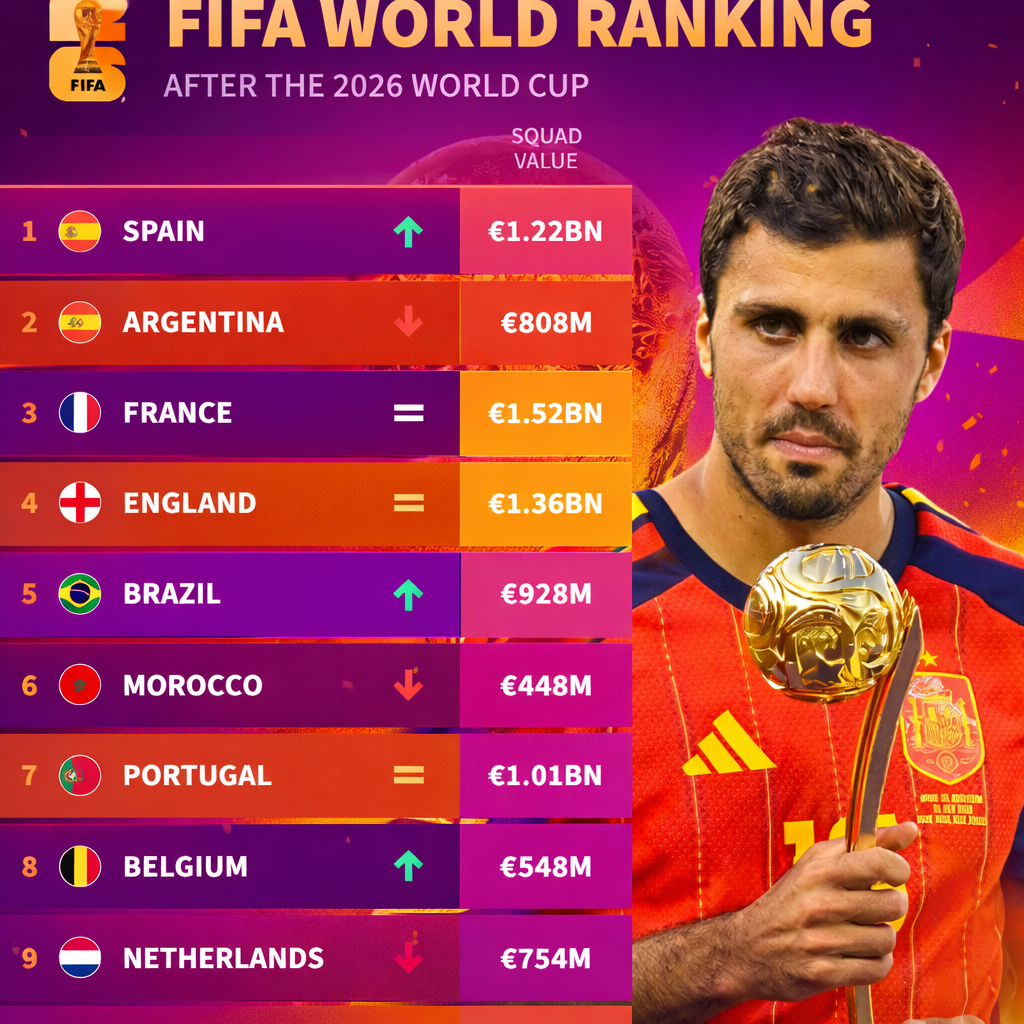
Spain’s rise to the top is a fitting reward for one of the most dominant World Cup campaigns in recent history.
Luis de la Fuente’s side began the competition with a surprising 0-0 draw against Cape Verde but responded by winning every remaining match. Spain defeated Saudi Arabia and Uruguay in the group stage before overcoming Austria, Portugal, Belgium and France in the knockout rounds.
They then defeated Argentina in the final through Ferran Torres’ extra-time goal, securing the country’s second World Cup title after its first triumph in 2010. Spain conceded only one goal throughout the entire tournament and allowed Argentina just two attempts across 120 minutes in the final.
Spain’s World Cup knockout journey
| Round | Result |
|---|---|
| Round of 32 | Spain 3-0 Austria |
| Round of 16 | Spain 1-0 Portugal |
| Quarter-final | Spain 2-1 Belgium |
| Semi-final | Spain 2-0 France |
| Final | Spain 1-0 Argentina after extra time |
Spain’s success was built on more than possession football. La Roja combined technical quality with defensive discipline, tactical adaptability and a new generation of outstanding players.
Rodri controlled the midfield and won the World Cup Golden Ball, while Pau Cubarsí formed part of a defence that was almost impossible to break down. Lamine Yamal, Nico Williams and Spain’s other attacking players provided creativity and directness.
As world champions, European champions and now the top-ranked men’s national team, Spain have established themselves as the standard every other country must attempt to reach.
Argentina Drop to Second After Final Defeat
Argentina entered the World Cup as the top-ranked team and defending champions. Despite losing the final, Lionel Scaloni’s side demonstrated why they remain one of international football’s strongest teams.
Their route to the final was more dramatic than Spain’s. Argentina needed resilience and late goals to overcome several difficult opponents before defeating England 2-1 in the semi-final.
Lionel Messi remained the team’s creative leader at 39, while Enzo Fernández, Julián Álvarez and Emiliano Martínez made important contributions throughout the campaign.
Argentina were unable to retain the trophy, but reaching another final ensured they remained second in the world rankings rather than suffering a major fall. They have now contested three of the last four World Cup finals, underlining the remarkable consistency of Scaloni’s team.
Spain’s victory therefore changed the order at the summit rather than ending Argentina’s position among the international elite.
France Remain Third Despite Finishing Fourth
France retained third place in the rankings despite losing their final two matches of the tournament.
Les Bleus reached the semi-finals after defeating Sweden, Paraguay and Morocco during the knockout stage. Their title hopes were ended by a 2-0 defeat to Spain before they lost an extraordinary bronze-medal match 6-4 to England.
France remained ahead of England because they entered the decisive stages with a sufficient rankings-point advantage to absorb the head-to-head defeat.
Kylian Mbappé was their outstanding performer. He scored 10 goals to win the Golden Boot and completed the tournament as its leading scorer.
France may have finished fourth, but their continued presence among the top three reflects the depth of talent available to the national team and their consistency across recent international competitions.
England Hold Fourth After Winning the Bronze Medal
England remained fourth in the FIFA rankings after completing their best World Cup campaign since winning the competition in 1966.
Thomas Tuchel’s side reached the semi-finals before suffering a painful 2-1 defeat to Argentina. They responded emphatically by beating France 6-4 in one of the most extraordinary third-place matches in World Cup history.
Bukayo Saka scored a hat-trick, while Declan Rice, Ezri Konsa and Jude Bellingham also found the net. FIFA confirmed that the victory gave England their best tournament finish since their 1966 title.
England’s unchanged ranking should not be mistaken for a lack of progress. Their World Cup performance showed that they can compete deep into major tournaments and recover strongly from disappointment.
Bellingham, Saka, Rice and other members of the squad should remain influential by the time Euro 2028 and the 2030 World Cup arrive.
Brazil Climb to Fifth Despite Early Elimination
Brazil moved up to fifth despite suffering another disappointing World Cup knockout.
The five-time champions defeated Japan 2-1 in the Round of 32 but were eliminated by Norway in the Round of 16. The defeat prevented Brazil from challenging for the trophy and extended their wait for a first World Cup title since 2002.
Their rise in the ranking reflects the total points collected over the ranking period rather than their tournament finish alone. FIFA’s system considers every eligible result, the quality of the opposition and the importance of each match.
Brazil remain one of international football’s strongest squads, but their World Cup performance exposed familiar concerns about consistency, tactical balance and delivering in knockout matches.
Moving into fifth place offers encouragement, although the national team will ultimately be judged by whether it can turn individual quality into success at future major tournaments.
Morocco Reach a Historic Sixth Place
Morocco’s climb to sixth is one of the most significant developments in the latest rankings.
The Atlas Lions produced another impressive World Cup campaign, defeating the Netherlands and tournament co-host Canada before reaching the quarter-finals. Their run was eventually ended by France.
The result strengthened Morocco’s position as Africa’s leading national team and took them to a historic high in the FIFA rankings.
Morocco are no longer viewed simply as a dangerous outsider. Their performances across consecutive World Cups have shown that they possess the organization, defensive quality and technical talent to compete consistently with established European and South American powers.
Reaching sixth also confirms the growing strength of African football. Morocco’s progress provides a model for nations seeking to combine domestic development, overseas-based talent and long-term tactical planning.
Portugal Fall to Seventh After Spain Defeat
Portugal dropped in the rankings following a disappointing Round-of-16 exit.
They defeated Croatia in the Round of 32 but were then eliminated 1-0 by neighbours Spain. The result ended their tournament before the quarter-finals despite entering the competition as one of the highly ranked contenders.
Portugal’s squad contained significant individual quality, but Spain limited their attacking influence and controlled the decisive moments of the Iberian derby.
Their fall below Brazil and Morocco reflects both their early knockout exit and the stronger performances produced by the nations that moved above them.
Portugal remain seventh and therefore inside the international elite, but the tournament raised questions about how they will transition toward the next generation.
Belgium Rise to Eighth After Quarter-Final Run
Belgium climbed into eighth after reaching the World Cup quarter-finals.
The Red Devils survived a dramatic 3-2 encounter with Senegal, defeated the United States 4-1 and then pushed Spain all the way in the last eight.
Belgium eventually lost 2-1 after conceding a late goal, but their performance represented an improvement on previous disappointing major tournaments.
A new generation of Belgian players showed that the country can remain competitive after the decline of its celebrated golden era. The team’s combination of experience and emerging talent provided enough positive results to move them above the Netherlands.
Their next task will be turning a respectable quarter-final appearance into a genuine title challenge.
Netherlands Drop to Ninth
The Netherlands fell to ninth after being eliminated by Morocco in the Round of 32.
The match ended level before Morocco progressed on penalties, giving the Dutch little opportunity to build momentum in the expanded knockout stage.
Early elimination was particularly damaging because the World Cup offers valuable ranking points due to the importance of its matches. FIFA’s model places greater weight on major tournament fixtures than ordinary friendlies.
The Netherlands remain within the top 10, but their campaign was a major disappointment for a country with a strong tournament history and several high-level players.
Their ranking position shows that they still possess a solid body of results, although improvement will be required to avoid falling further.
Mexico Return to the Top 10
Mexico were among the biggest beneficiaries of the tournament, climbing four places to 10th.
The co-hosts defeated Ecuador in the Round of 32 before losing a thrilling 3-2 match to England in the Round of 16. Their overall World Cup performance was strong enough to return them to the top 10 for the first time since March 2022.
Mexico’s rise is important for the CONCACAF region. They finished the tournament as its highest-ranked national team, ahead of the United States, which moved to 16th.
Home support, improved attacking confidence and the ability to handle knockout pressure contributed to Mexico’s positive campaign.
Although they did not reach the quarter-finals, their return to the top 10 suggests that the World Cup created a platform from which the national team can continue developing.
Norway Make the Biggest Leap to 19th
Norway deserve an honourable mention after producing one of the tournament’s most impressive runs.
Led by Erling Haaland, Norway reached the World Cup quarter-finals and climbed 12 places from 31st to 19th, making them the biggest mover in the latest leading rankings update.
Their rise was built on important victories during the knockout rounds.
Norway defeated Ivory Coast 2-1 in the Round of 32 before producing one of the tournament’s biggest shocks by eliminating Brazil 2-1 in the Round of 16.
England eventually ended their campaign with a 2-1 quarter-final victory, but Norway’s progress had already transformed perceptions of the team.
Norway’s World Cup knockout results
| Round | Result |
|---|---|
| Round of 32 | Norway 2-1 Ivory Coast |
| Round of 16 | Norway 2-1 Brazil |
| Quarter-final | England 2-1 Norway |
Haaland gave Norway a world-class focal point in attack, but the team’s success was not dependent on one player alone. Their defensive organization, willingness to press and ability to attack quickly made them difficult opponents.
Reaching 19th represents an important milestone for a country that had been outside the global top 30 before the tournament.
Norway’s challenge will now be maintaining that level through European qualification and future Nations League matches. One impressive tournament can create momentum, but staying inside the top 20 requires consistent results.
Why Norway’s Rise Matters
Norway’s climb illustrates how quickly a strong World Cup can transform a country’s international status.
Victories over higher-ranked opponents such as Brazil deliver significant points because FIFA’s formula considers both opponent strength and expected match outcome. Beating a traditional powerhouse therefore has a larger rankings impact than defeating a much lower-ranked side.
The rise could also have practical benefits. Ranking position may influence seeding in future international draws, potentially improving Norway’s path in upcoming competitions.
More importantly, the tournament demonstrated that Haaland’s generation is capable of competing with elite national teams rather than merely qualifying for major events.
Biggest Winners From the Post-World Cup Rankings
Spain
Winning the trophy and moving to No.1 completed the perfect tournament.
Morocco
Sixth place confirms their emergence as a consistent international power and Africa’s leading side.
Mexico
Returning to the top 10 provides an important boost after a strong home World Cup campaign.
Norway
Jumping from 31st to 19th was the biggest improvement among the tournament’s major performers.
England
Although they remained fourth, winning bronze strengthened their status as genuine contenders for future trophies.
What the Ranking Says About World Football
The new rankings show that international football is becoming more competitive.
Spain and Argentina remain at the summit, but Morocco’s rise demonstrates that nations outside Europe and South America can establish themselves near the top.
Norway’s quarter-final run offers another example of a developing team using elite attacking talent and tactical discipline to overcome traditional powers.
Mexico’s return to the top 10 also strengthens CONCACAF’s representation, while England’s bronze medal confirms their continued progress.
The rankings still feature many familiar names, but the movement below the top four suggests that the balance of international football is gradually changing.
Conclusion
Spain’s rise to No.1 in the FIFA rankings is the natural conclusion to an outstanding World Cup campaign.
La Roja won seven consecutive matches after their opening draw, conceded only one goal and defeated defending champions Argentina in the final. Their combination of experienced leaders and exceptional young players made them worthy champions and the strongest men’s national team in the world.
Argentina remain close behind after reaching another final, while France and England retain their places in the top four. Brazil moved into fifth despite an early exit, Morocco reached a historic sixth and Mexico returned to the top 10.
Norway provided the rankings’ most striking rise. Their victories over Ivory Coast and Brazil carried them to the quarter-finals and lifted them from 31st to 19th.
The 2026 World Cup therefore did more than crown Spain champions. It reshaped the international football hierarchy and introduced several teams capable of challenging the established powers in the years ahead.
Frequently Asked Questions
Which country is No.1 in the FIFA rankings after the 2026 World Cup?
Spain are ranked first after winning the World Cup final against Argentina.
Who are the top five teams in the latest FIFA rankings?
The top five are Spain, Argentina, France, England and Brazil.
What position are Morocco in the FIFA rankings?
Morocco are sixth after reaching the World Cup quarter-finals and recording their highest-ever ranking.
How far did Norway climb?
Norway climbed 12 places from 31st to 19th after reaching the World Cup quarter-finals.
What position are Mexico in?
Mexico moved four places to 10th, returning to the FIFA top 10 for the first time since March 2022.
How are FIFA rankings calculated?
FIFA uses an Elo-based model that considers the result, match importance, relative team strength and expected result