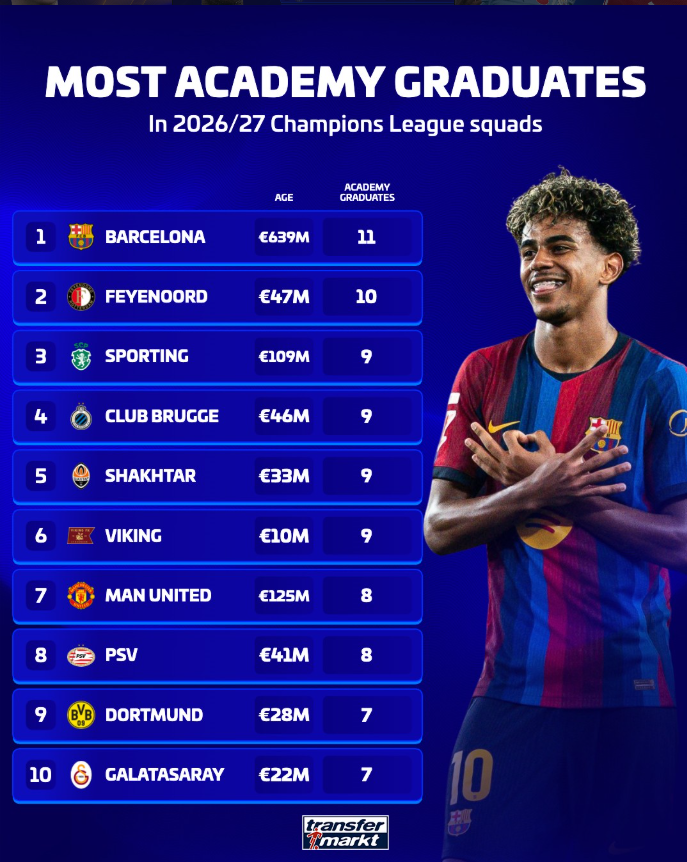
Barcelona have more academy graduates in their 2026/27 UEFA Champions League squad than any other club in the competition, according to figures published by Transfermarkt.
The Spanish giants named 11 former academy players in their European squad, one more than second-placed Feyenoord. The Barcelona graduates have an estimated combined market value of €639 million, highlighting both the quantity and exceptional quality produced by the famous La Masia system.
Manchester United sit seventh with eight academy graduates valued at approximately €125 million. The Red Devils are the only English club to feature among the leading 10 teams.
The rankings demonstrate why a productive youth academy can be just as valuable as an ambitious transfer strategy.
Champions League Clubs With the Most Academy Graduates
The supplied data ranks the clubs as follows:
| Rank | Club | Academy graduates | Combined market value |
|---|---|---|---|
| 1 | Barcelona | 11 | €639m |
| 2 | Feyenoord | 10 | €47m |
| 3 | Sporting CP | 9 | €109m |
| 4 | Club Brugge | 9 | €46m |
| 5 | Shakhtar Donetsk | 9 | €33m |
| 6 | Viking | 9 | €10m |
| 7 | Manchester United | 8 | €125m |
| 8 | PSV Eindhoven | 8 | €41m |
| 9 | Borussia Dortmund | 7 | €28m |
| 10 | Galatasaray | 7 | €22m |
These numbers count academy graduates included in the clubs’ Champions League squads. The market-value figures are estimates rather than transfer fees, but they help illustrate the potential financial value created by youth development. Transfermarkt’s full academy-graduate ranking
Barcelona and the Continuing Success of La Masia
Barcelona’s position at the top is not surprising. La Masia has been responsible for producing some of the most technically gifted footballers of different generations.
The academy trains young players to understand Barcelona’s football philosophy from an early age. Graduates arrive in the senior squad already familiar with the club’s preferred style, expectations and tactical principles.
Lamine Yamal is the clearest modern example of that pathway. He progressed through Barcelona’s youth system before becoming a major first-team player and one of the world’s most valuable young footballers.
Other academy-developed players have provided Barcelona with quality in defence, midfield and attack. The presence of 11 graduates means the club can maintain a strong identity while still adding experienced signings where necessary.
Their combined €639 million valuation is significantly higher than any other club on the list. It shows that academy investment can create elite players who would cost enormous amounts to replace through the transfer market.
Manchester United Remain England’s Leading Academy Club
Manchester United are the only English club among the top 10, with eight academy graduates included in their Champions League squad.
Youth development has always formed an important part of United’s identity. From the Busby Babes to the Class of ’92 and more recent first-team graduates, the club has a long tradition of giving academy players senior opportunities.
United’s graduates carry a combined estimated value of €125 million—the second-highest total among the teams in this ranking. Only Barcelona’s academy group is valued more highly.
This is particularly important in an era when Premier League clubs regularly spend huge amounts on transfers. Producing a first-team player internally can save millions while preserving the club’s connection with its supporters.
Manchester United’s continued presence in this ranking suggests that their academy remains productive even when the senior team experiences periods of change.
Why Academy Players Are Valuable to Football Clubs
A successful academy offers much more than a supply of young substitutes. It can improve a club’s finances, squad planning, culture and long-term competitiveness.
1. Academies Reduce Transfer Costs
Signing an established first-team player can require a huge transfer fee, agent commission and expensive wages. An academy graduate can fill the same position without the club paying another team for his registration.
Development is not free, but a strong academy can offer far better long-term value than repeatedly buying players from the transfer market.
Barcelona’s €639 million collection of academy talent demonstrates the size of that potential return.
2. Young Players Understand the Club’s Identity
Academy players spend years learning how their club wants to play. They understand its traditions, tactical language and standards before reaching the senior squad.
That familiarity can make promotion to the first team smoother. Coaches do not always need to start from the beginning when explaining the team’s playing style.
Young graduates can also help preserve an identity when managers and senior players change.
3. Homegrown Players Strengthen the Connection With Supporters
Fans often form a special relationship with footballers who have grown up at their club.
Supporters have watched those players develop from youth prospects into senior professionals. When an academy graduate succeeds, fans can feel that the player represents both the team and its community.
That connection is difficult to recreate through expensive transfers.
4. Academy Graduates Help With Squad-Registration Rules
UEFA competitions require clubs to reserve places for locally trained and club-trained players. A productive academy makes it easier to satisfy these rules without weakening the squad.
Clubs that fail to develop enough eligible players can be forced to register smaller European squads. Academy graduates therefore offer both football and administrative value.
5. Youth Development Can Generate Transfer Income
Not every prospect will become a regular first-team player. However, academy graduates can still create valuable income when they are sold.
Because clubs have not paid external transfer fees to acquire homegrown players, successful sales can produce significant accounting profits. That money can then be reinvested in the academy, senior squad or club infrastructure.
Well-managed academies create a cycle in which player development supports financial sustainability.
Feyenoord and Sporting Continue Their Development Traditions
Barcelona may lead the ranking, but Feyenoord and Sporting CP also deserve recognition.
Feyenoord have 10 graduates in their Champions League squad, while Sporting are one of four teams with nine. Both clubs operate in leagues where selling players to wealthier European teams is an important part of the business model.
Sporting have built an international reputation for producing technically skilled footballers and giving them senior opportunities. Feyenoord’s position demonstrates the continued strength of football development in the Netherlands.
Club Brugge, Shakhtar Donetsk, Viking and PSV also show that clubs do not need Premier League-level budgets to build competitive pathways.
Why Clubs Must Give Young Players Real Opportunities
Investing in facilities and coaches is only one part of academy development. Young players must also receive genuine first-team opportunities.
A prospect cannot complete his development without competitive minutes. Training with senior players is valuable, but playing in meaningful matches teaches decision-making, physical resilience and how to perform under pressure.
Clubs should create a clear pathway between their youth and senior teams. This can include:
- Coordinating tactics across different age groups
- Allowing talented prospects to train with the first team
- Using domestic cup matches to provide competitive experience
- Selecting loan clubs based on development rather than convenience
- Hiring specialist coaches for individual improvement
- Giving young players time to learn from mistakes
Managers also need support from club leadership. Coaches under constant pressure to achieve immediate results may choose experienced players even when a talented academy prospect is ready.
Academy Investment Is a Long-Term Football Strategy
The 2026/27 Champions League rankings provide a powerful lesson for clubs across Europe.
Barcelona lead because youth development is deeply connected to their football identity. Manchester United’s position as England’s only representative in the top 10 shows that their academy tradition remains one of the club’s greatest strengths.
Buying established players will always be part of elite football. However, transfers should complement a strong academy rather than replace it.
The clubs that invest in coaching, scouting, education and first-team pathways can produce valuable players, reduce transfer spending and build squads with a genuine connection to supporters.
Young talent requires patience, but the potential rewards are enormous. Barcelona’s 11 graduates and their estimated €639 million value provide convincing evidence that investing in an academy can shape both a club’s present and its future.
Football supporters can follow Barcelona, Manchester United and the other Champions League clubs on Bangbet. Check current form, squad news and available odds before placing a bet. Set a clear budget and always play responsibly.