What the Data Reveals About Coaching Greatness
In modern football, managers often define their legacy not only through trophies won, clubs coached, or star players developed, but also through measurable performance metrics. One of the most revealing indicators of managerial excellence is win percentage—a clean, numerical summary of how consistently a coach leads teams to victory over the course of their career.
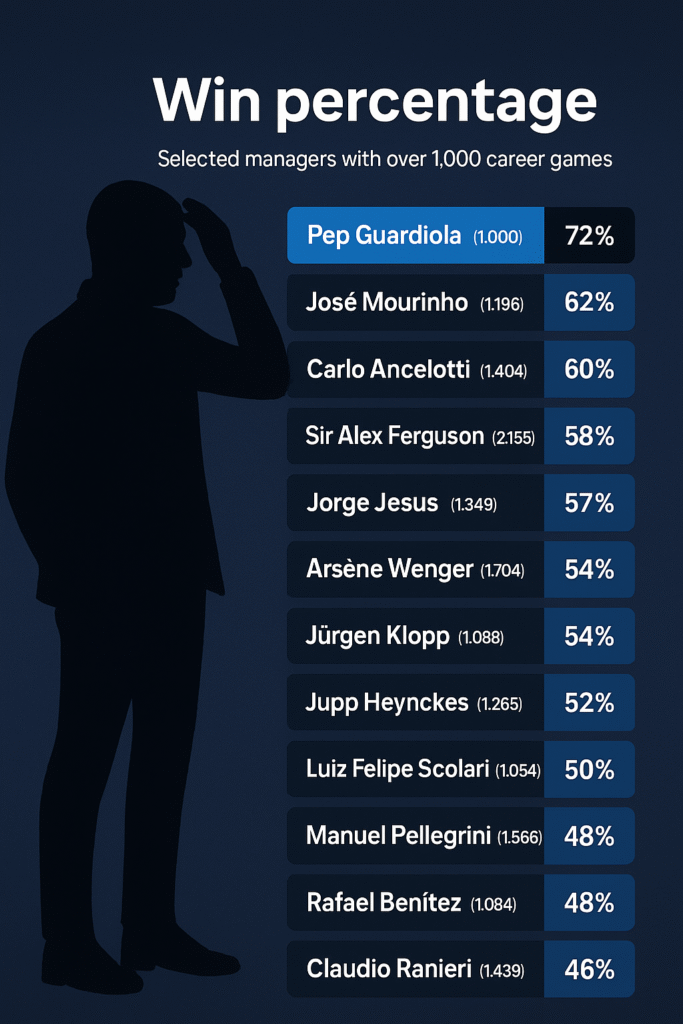
A graphic highlighting selected managers with more than 1,000 career matches provides a compelling look into how some of European football’s most influential tacticians compare. The ranking features some of the most accomplished coaches in history, showcasing the elite company at the top and offering insights into what sets them apart.
Win Percentage: The Ultimate Benchmark in Football Management
While trophies remain the most celebrated currency of football success, win percentage reflects a manager’s week-to-week dominance, tactical consistency, and long-term performance across leagues, clubs, and eras. It neutralizes advantages like budget, squad depth, or league competitiveness and instead shows a sustained pattern of winning.
The data presented gives fans and analysts a clearer way to compare managerial success beyond traditional narratives.
Breakdown of Win Percentages Among Top Managers (1,000+ Games)
The ranking displayed in the image includes the following win percentages:
- Pep Guardiola – 72%
- José Mourinho – 62%
- Carlo Ancelotti – 60%
- Sir Alex Ferguson – 58%
- Jorge Jesus – 57%
- Arsène Wenger – 54%
- Jürgen Klopp – 54%
- Unai Emery – 53%
- Jupp Heynckes – 52%
- Luiz Felipe Scolari – 50%
- Manuel Pellegrini – 48%
- Rafael Benítez – 48%
- Claudio Ranieri – 46%
These figures represent cumulative win rates across massive sample sizes—each manager has coached over 1,000 competitive fixtures, making the percentages both credible and statistically significant.
Why Guardiola’s 72% Stands Apart
The chart’s top figure—72%—is an extraordinary achievement in football management. Maintaining such a win rate across 1,000 games signals:
- Tactical evolution across leagues
- Elite squad management
- High-performance consistency
- Success in domestic and international competitions
This level of sustained excellence places him in a distinct category within football history.
The Competitive Middle Tier: Mourinho, Ancelotti, Ferguson
The next tier—ranging from 60% to 58%—includes some of the most decorated and influential managers in world football. Their success is built on:
- Multiple league titles across countries
- Strong records in UEFA competitions
- Longevity at top clubs
- Adaptability over decades
This grouping reflects managers who not only won frequently but shaped the modern game tactically and culturally.
The 50%+ Category: Depth, Durability, and Global Impact
Managers in the 50–57% range—such as Jorge Jesus, Wenger, Klopp, Emery, and Heynckes—are among the most respected tacticians in European and global football. Their win percentages reflect:
- Long-term contributions across several clubs
- Development of world-class players
- Tactical innovation
- Consistent presence in European competitions
These coaches often led transitional squads, developed youth talent, and built the foundations of long-lasting football identities.
The Sub-50% Group: Still Among the Elite
Even the lowest percentages listed—46% to 50%—represent remarkable achievements, considering:
- Vast sample sizes (1,000+ matches)
- Managing in top-flight leagues
- Rebuilding clubs or taking over underperforming squads
- Success in multiple continents and competitions
These managers have had careers defined by longevity, adaptability, and tactical intelligence.
What This Ranking Tells Us About the Modern Manager
1. Longevity Amplifies Difficulty
Sustaining a high win percentage across decades is far more difficult than short-term success.
2. Tactics Evolve—Win Rates Reflect That
Managers with high win percentages consistently reinvent their systems to match the modern game.
3. Club Context Matters—But Numbers Don’t Lie
Whether leading elite squads or rebuilding mid-table teams, consistent winning requires tactical excellence and leadership.
4. International Success Influences Percentages
Many listed managers balanced both club and national team duties, adding complexity to their records.
Final Thoughts: Win Percentage as a Legacy Marker
While win percentage is not the only measure of greatness, it is one of the clearest indicators of a manager’s competitive performance over time. The data in this ranking reflects not only dominance but also durability, adaptability, and the evolution of football philosophy.
In an era where clubs and fans demand both immediate results and long-term stability, win percentage remains a powerful metric—one that will continue to shape debates about managerial greatness for years to come.
BET WITH BANGBET FOR ALL FOOTBALL GAMES AND CASINO!! GET EXCLUSIVE ODDS AND HIGH RETURN.
Bangbet More Than Win!