


Sports betting offers different ways to predict match outcomes, compare odds, and place wagers. Two popular models are sportsbooks and sports betting exchanges. Although both let sports fans stake money on sporting events, they operate differently, especially in how they set odds, manage bets, and determine potential returns.
For Kenyan sports fans who follow the FKF Premier League, English Premier League, UEFA Champions League and international football competitions, understanding these differences can help them make more informed betting decisions.
So, how do odds differ between a sportsbook and a sports exchange? What makes each model unique, and which one offers a better betting experience?
Let’s break it down.
1. What Is a Sportsbook?
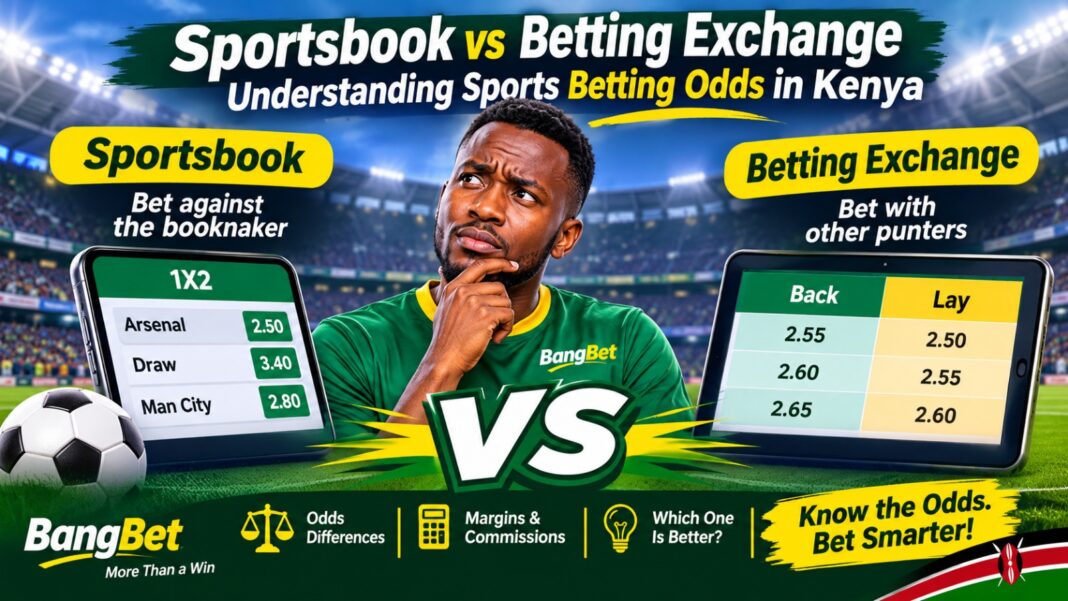
A sportsbook is a betting platform that sets its own odds for sporting events and offers them to customers. The sportsbook acts as the bookmaker, accepting bets from players and paying out winning wagers according to the odds displayed when the bet is accepted.
For example, ahead of an English Premier League fixture between Arsenal and Manchester City, a sportsbook might offer:
| Match outcome | Example odds |
| Arsenal win | 2.50 |
| Draw | 3.40 |
| Manchester City win | 2.80 |
These are illustrative odds, not live match prices.
The sportsbook calculates its odds using factors such as team performance, player availability, historical results, home advantage and betting-market expectations.
It also includes a bookmaker’s margin, commonly called the overround, which helps the operator generate revenue over time.
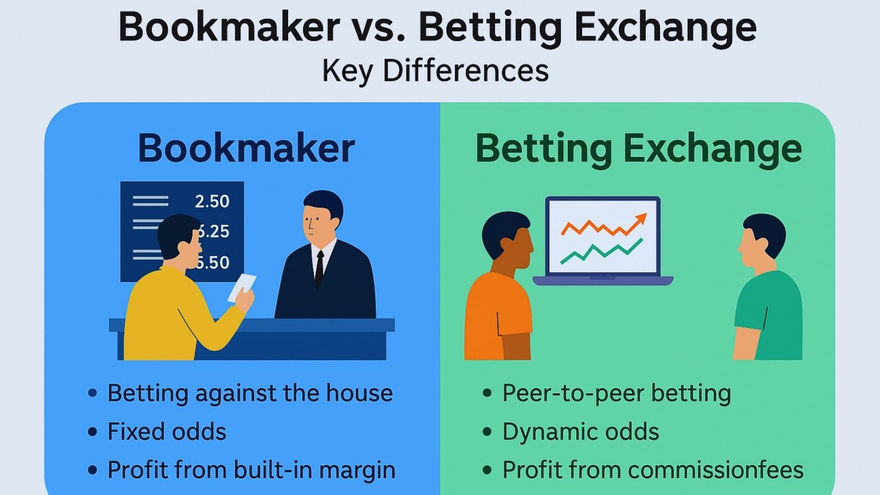
The key point: In a sportsbook, you place your bet against the bookmaker. The bookmaker sets the odds and accepts the risk associated with the wager.
2. What Is a Sports Betting Exchange?
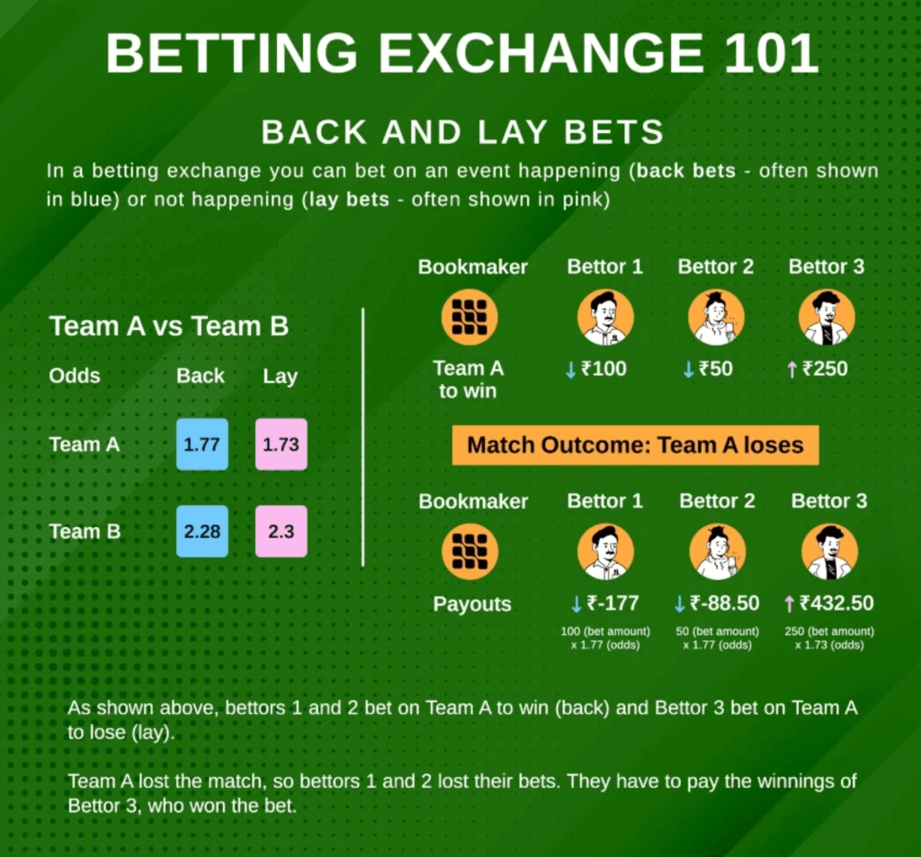
A sports exchange operates differently. Instead of betting directly against a bookmaker, customers trade betting positions with other customers through a platform.
The exchange provides a marketplace where users can offer and accept odds.
There are two main ways to participate:
- Back betting: You back a team or outcome to happen. This is similar to placing a conventional sportsbook bet.
- Lay betting: You bet against a particular outcome, effectively taking the position that it will not happen.
For example, imagine a football match between Gor Mahia and AFC Leopards.
One exchange user might offer odds of 2.50 on Gor Mahia to win. Another user can accept those odds by backing Gor Mahia. Alternatively, someone can lay Gor Mahia, taking the opposite position.
The exchange typically charges a commission on net winnings rather than relying on a traditional bookmaker’s margin.
The key point: In a sports exchange, customers bet against other customers, while the platform facilitates the transaction.
3. How Do Odds Differ Between a Sportsbook and a Sports Exchange?
The biggest difference is how odds are created and influenced.
In a sportsbook, the bookmaker sets the prices. In an exchange, odds are shaped by the offers and demands of participating users.
Here is a closer comparison:
| Feature | Sportsbook | Sports exchange |
| Who sets the odds? | The bookmaker | Market participants |
| Who do you bet against? | The bookmaker | Another exchange user |
| Odds formation | Bookmaker pricing models | Supply and demand |
| Revenue model | Bookmaker’s margin | Usually commission on net winnings |
| Back betting | Yes | Yes |
| Lay betting | Generally no | Yes |
| Bet matching | The bookmaker accepts bets | Available offers must be matched |
| Liquidity | Managed by the bookmaker | Depends on available market participants |
An exchange may sometimes offer better odds than a sportsbook because its prices reflect competing offers from users. However, this is not guaranteed.
Sportsbook odds can also be competitive, particularly when operators adjust prices to attract customers.
Ultimately, the best odds depend on the specific match, market, timing and available prices.
4. Understanding the Difference Through a Betting Example
Let’s consider a hypothetical match between Manchester United and Liverpool.
Suppose you want to back Manchester United to win.
- A sportsbook offers odds of 2.40.
- A sports exchange offers odds of 2.55.
- The exchange charges a hypothetical 5% commission on net winnings.
If you stake KSh1,000, the potential returns would look like this:
| Calculation | Sportsbook | Sports exchange |
| Stake | KSh1,000 | KSh1,000 |
| Odds | 2.40 | 2.55 |
| Gross return | KSh2,400 | KSh2,550 |
| Gross profit | KSh1,400 | KSh1,550 |
| Commission | KSh0 | KSh77.50 |
| Net profit | KSh1,400 | KSh1,472.50 |
In this illustration, the exchange produces a higher net profit despite its commission.
However, the comparison assumes that the exchange has sufficient liquidity to match the entire stake at 2.55 and that the stated commission applies to the net winnings.
The lesson is simple: Never compare odds without considering commission, stake limits and the final amount you could receive.
5. What Is the Bookmaker’s Margin?
The bookmaker’s margin is one of the most important concepts when comparing sportsbook odds with exchange prices.
A sportsbook generally builds a margin into its odds. This means the combined implied probabilities of all possible outcomes exceed 100%.
For example, consider these hypothetical 1X2 odds:
- Home win: 2.50
- Draw: 3.40
- Away win: 2.80
The implied probabilities are calculated by dividing 1 by each decimal odd.
The combined percentage is:
[
\frac{1}{2.50}+\frac{1}{3.40}+\frac{1}{2.80}
=105.55%
]
The 5.55% above 100% represents the overround.
An exchange generally operates differently because it matches opposing positions and charges commission according to its pricing structure.
However, exchanges are not automatically cheaper. Commission, price spreads, and liquidity can all affect a transaction’s value.
6. Advantages and Disadvantages of Sportsbooks and Sports Exchanges
Both betting models have benefits and limitations.
Advantages of Sportsbooks
- Simplicity: Bettors select an outcome and place a stake without finding another customer to match their bet.
- Convenience: Markets and odds are displayed in an organized betting interface.
- Predictable payouts: Potential returns are calculated using the accepted odds and stake.
- Variety: Sportsbooks commonly offer markets covering football, basketball, tennis and other sporting competitions.
Disadvantages of Sportsbooks
- Odds include a bookmaker’s margin.
- Customers generally cannot lay outcomes.
- The operator controls prices and available markets.
- Odds can change before a bet is accepted.
Advantages of Sports Exchanges
- Users can potentially access competitive odds.
- Back and lay betting provide more flexibility.
- Customers can compare prices offered by different participants.
- Some exchanges allow users to trade positions before an event finishes.
Disadvantages of Sports Exchanges
- A bet may not be matched if liquidity is insufficient.
- Commission reduces net winnings.
- Understanding lay betting requires additional knowledge.
- Prices can fluctuate as market demand changes.
7. Which Is Better for Kenyan Sports Bettors?
The answer depends on your betting preferences, experience and the type of betting experience you want.
For beginners, a sportsbook is often easier to understand because the bookmaker provides the odds, and the customer simply chooses an outcome and stake.
For more experienced users who understand market prices, back and lay positions, commission and liquidity, an exchange may provide additional flexibility.
Kenyan football enthusiasts who follow competitions such as the FKF Premier League, English Premier League, UEFA Champions League and Africa Cup of Nations should also consider the availability of relevant markets, payment convenience, platform reliability and applicable local regulations.
Regardless of the model, remember that higher odds do not automatically mean a better bet. Odds represent the price offered for an outcome, not a guarantee that it will happen.
8. Explore Sports Betting with BangBet Kenya
Looking for an accessible platform to enjoy sports betting? BangBet offers sports betting opportunities for fans who want to follow their favorite teams and competitions while exploring different betting markets.
Whether you are analyzing an upcoming Premier League fixture, following the FKF Premier League, or keeping up with international football, BangBet provides a platform to explore available odds and sports markets.
You can also discover betting promotions and other platform features, subject to their applicable terms and conditions. Visit BangBet to explore the sports betting experience, check current markets, and learn more about the platform.
Remember to understand the odds before placing a wager, set a budget and treat sports betting as entertainment rather than a source of income.
Conclusion: Sportsbook vs. Sports Exchange – Understanding the Odds Matters
The main difference between a sportsbook and a sports exchange comes down to how betting prices are determined and who takes the opposite side of your wager.
A sportsbook sets its own odds and acts as the bookmaker, while a sports exchange connects customers who want to back or lay different outcomes. Exchanges can offer competitive prices, but you should consider commission and liquidity before deciding whether an offer represents better value.
For Kenyan sports fans, understanding these differences is an important step towards becoming more informed bettors. Whether you prefer the straightforward structure of a sportsbook or the flexibility of an exchange, always compare the available odds, understand the terms and make responsible decisions.