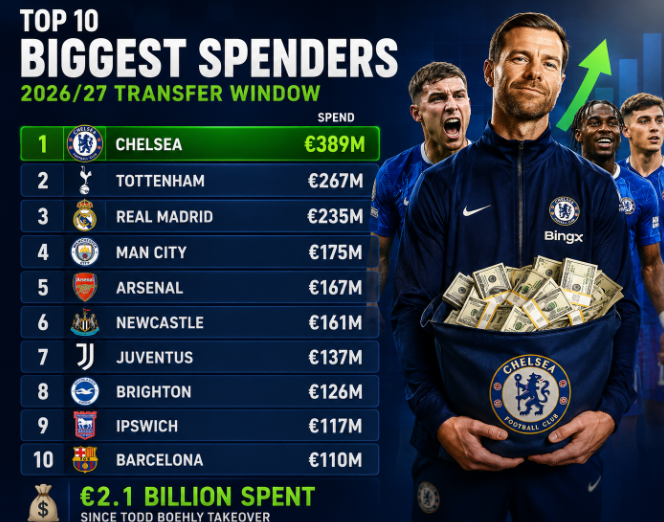
Chelsea have emerged as the biggest spenders of the 2026/27 transfer window, with the Blues’ expenditure put at a remarkable €389 million as the club continues its aggressive investment in the squad.
The figure places Chelsea comfortably ahead of Tottenham, who sit second in the spending rankings at €267 million, while Real Madrid are third at €235 million.
Manchester City (€175m) and Arsenal (€167m) complete the top five, meaning four of the five biggest spenders shown in the supplied rankings are Premier League clubs.
Chelsea’s latest spending also continues a remarkable period of investment since the Todd Boehly-led ownership group took control of the club. The supplied information puts their total transfer spending over that period at approximately €2.1 billion.
The financial commitment is enormous. The bigger question now is whether Chelsea can turn that investment into sustained results — and that is also where the story becomes particularly interesting from a Premier League betting perspective.
Chelsea Top Transfer Spending Rankings at €389m
Chelsea are not simply first in the rankings. Their reported expenditure gives them a sizeable lead over their closest rivals.
According to the figures provided, the top 10 spenders for 2026/27 are:
| Rank | Club | Spending |
|---|---|---|
| 1 | Chelsea | €389m |
| 2 | Tottenham | €267m |
| 3 | Real Madrid | €235m |
| 4 | Manchester City | €175m |
| 5 | Arsenal | €167m |
| 6 | Newcastle United | €161m |
| 7 | Juventus | €137m |
| 8 | Brighton | €126m |
| 9 | Ipswich Town | €117m |
| 10 | Barcelona | €110m |
The gap between Chelsea and Tottenham stands at €122 million, while Chelsea’s expenditure is more than double Manchester City’s figure in the graphic.

Another striking feature is the dominance of English clubs.
Seven of the 10 teams listed are from England, with Real Madrid, Juventus and Barcelona the only clubs from outside the Premier League system to feature.
Chelsea’s Spending Under Todd Boehly Reaches Another Level
Chelsea’s position at the top of the latest rankings continues the club’s extraordinary transfer activity under its current ownership.
The supplied figure of €2.1 billion spent since Todd Boehly’s takeover illustrates the scale of the rebuilding project.
Chelsea have repeatedly invested in younger players and long-term squad development, creating a large pool of talent designed to compete both immediately and over several seasons.
Spending €389 million in another transfer window suggests that strategy is continuing.
But transfer expenditure is only one side of the equation.
Chelsea must now demonstrate that the investment can translate into performances, trophies and consistent results.
Chelsea Spend €122m More Than Tottenham
The difference between Chelsea and second-placed Tottenham helps put the numbers into perspective.

At €389 million compared with Tottenham’s €267 million, Chelsea have spent approximately 46% more than their London rivals based on the supplied figures.
Real Madrid’s €235 million investment is also €154 million below Chelsea’s total.
Perhaps most strikingly, Chelsea’s reported €389 million expenditure is €47 million more than Manchester City and Arsenal’s figures combined (€342 million).
Those comparisons underline just how aggressive Chelsea’s recruitment has been.
Yet football history repeatedly shows that winning a transfer window and winning on the pitch are two different things.
Premier League Clubs Dominate the Biggest Spenders List
Chelsea are the headline story, but the wider rankings also demonstrate the Premier League’s considerable financial strength.
Tottenham, Manchester City, Arsenal, Newcastle, Brighton and Ipswich all join Chelsea in the top 10.
That means the English clubs listed account for approximately €1.4 billion of the €1.884 billion represented across all 10 teams.
Real Madrid remain Europe’s biggest non-English spender in the supplied graphic at €235 million, with Juventus at €137 million and Barcelona at €110 million.
The level of Premier League investment could have consequences throughout the table.
It is not simply the traditional title contenders strengthening. Clubs competing for European places and elsewhere in the division are also investing heavily.
Does Spending €389m Make Chelsea Premier League Title Contenders?

This is where expenditure meets expectations.
A €389 million transfer outlay inevitably increases the pressure on Chelsea to challenge towards the top of the Premier League.
However, transfer spending alone should not be treated as evidence that Chelsea will win the title.
Squad quality matters, but so do tactical cohesion, injuries, fixture congestion, individual form and how quickly new signings adapt.
Chelsea also have to compete against established Premier League rivals including Manchester City and Arsenal, both of whom appear in the top five spending rankings themselves.
From a betting-analysis perspective, therefore, the important question is not simply how much Chelsea have spent.
It is whether their improvement on the pitch justifies their price in the market.
Betting Angle: What Chelsea’s Spending Could Mean for Premier League Markets
Chelsea’s investment could have implications across several Premier League betting markets.
Chelsea to Win the Premier League
The outright Premier League winner market will be one of the obvious areas of attention.
A heavily strengthened Chelsea squad could potentially close the gap on the leading contenders, but bettors should compare that squad improvement against the odds being offered.
A shorter price following high-profile transfer activity does not necessarily represent better value.
Pre-season results, the opening fixtures and how quickly new players settle into the system could provide considerably more information.
Chelsea Top-Four Betting
The Premier League top-four market could be another area influenced by Chelsea’s transfer activity.
Spending €389 million suggests the club expects to compete at the highest level domestically.
But the competition could be intense.
Arsenal (€167m), Manchester City (€175m), Tottenham (€267m) and Newcastle (€161m) all feature prominently in the spending rankings.
Transfer activity across those clubs means the battle for Champions League qualification could become one of the most competitive markets of the season.

Chelsea Match Betting
Chelsea’s squad depth could also affect individual match markets.
Markets worth assessing throughout the season can include match result, total goals, both teams to score and player goalscorer markets, depending on the opposition and available prices.
Squad rotation becomes particularly important when Chelsea face congested schedules.
Rather than assuming a team with expensive signings should automatically win, bettors can consider confirmed line-ups, injuries, recent performance, home and away records, opposition quality and the available odds.
Player Betting Markets
Major transfer windows also create new player markets.
New Chelsea attackers could feature in anytime goalscorer, assists, shots and season goals markets, while established players may face greater competition for minutes.
That makes team selection particularly important.
A player’s transfer fee or reputation does not guarantee starts, goals or assists. Early-season minutes and tactical roles can provide more useful betting information than the size of the transfer fee itself.
Chelsea’s €389m Gamble Must Now Deliver on the Pitch
Chelsea’s latest expenditure represents another major commitment to the club’s long-term project.
According to the supplied figures, €389 million makes Chelsea Europe’s biggest spender of the 2026/27 window, €122 million clear of Tottenham and €154 million ahead of Real Madrid.
Combined with the reported €2.1 billion spent since the ownership change, expectations will understandably be substantial.
But money does not award Premier League points.
Chelsea’s recruitment will ultimately be judged by how successfully the individual pieces combine on the pitch. For bettors, that distinction is important too: transfer expenditure can provide useful context when assessing a team’s potential, but current form, line-ups, injuries, tactical performance and the price available remain critical factors.
The Blues may have won the spending race.
The next challenge is turning that investment into results.